You are not buying a toaster. You are deciding who gets a key to your house, who is alone in it with your jewelry box and your dog, and who you will be arguing with if a countertop gets ruined.
For most people that decision comes down to a star rating and a column of reviews. So it is worth knowing which of those reviews were written by actual customers — and which ones were bought, traded, or typed by a machine.
After 21 years and more than 36,000 cleanings in Albuquerque, we have read a lot of reviews, ours and everybody else’s. The fakes have a smell. Here is how to catch it.
Fake reviews are now illegal — and still everywhere
In August 2024 the Federal Trade Commission issued a final rule banning fake and false consumer reviews, including AI-generated ones. It bans buying positive reviews, buying negative reviews about a competitor, reviews written by company insiders that do not disclose the connection, and threatening customers to get a bad review taken down. The rule took effect in October 2024, and it lets the FTC seek civil penalties against knowing violators (Federal Trade Commission).
Illegal has not meant gone. Google says that in 2024 alone it blocked or removed more than 240 million policy-violating reviews, took down more than 12 million fake Business Profiles, and put posting restrictions on more than 900,000 accounts (Google).
Two things follow from numbers that size.
First, a great many fake reviews are being written, or there would be nothing to remove.
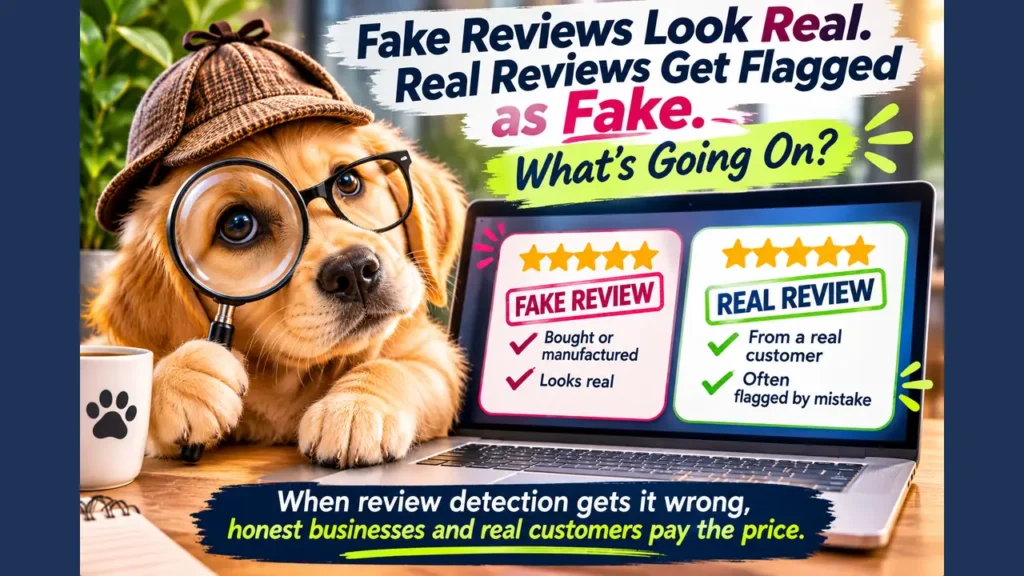
Second — and this is the part nobody warns you about — no human being is reading 240 million reviews. That is an algorithm making the call, and the people manufacturing reviews have spent years learning exactly what it looks for. The fakes have gotten good enough to slip past it. Which means the filter has to swing harder, and when it swings harder it takes down honest reviews from real customers along with the junk. Google says its AI now goes back and re-examines reviews for abuse patterns months after they were posted, so a review that has sat on a profile for years can vanish on a Tuesday.
That is the state of the thing you are about to use to pick a cleaning company: the fakes are getting better at looking real, and real reviews are getting caught in the net meant for them. So do not read the star rating. Read the reviews.
Tell #1: They all sound like the same person wrote them
This is the big one, and it is the easiest to see once you look for it.
Read five five-star reviews in a row. Fakes are uniform. Same length, same rhythm, same handful of words: professional, on time, thorough, exceeded expectations, highly recommend, attention to detail. Different names at the top, one voice underneath.
Real reviews are lopsided and a little messy. Real people write run-on sentences. They mention the dog. They spell a word wrong. They give five stars and still complain about one thing. One writes four words, the next writes four paragraphs about her mother-in-law’s visit.
AI-written reviews have their own tell: too tidy. Clean paragraphs, perfect punctuation, no typos, and a weirdly even temperature — enthusiastic in a way that never quite lands on anything specific. Nobody says “attention to detail” out loud. Nobody says it twice in a row under two different names.
Why they sound alike: sometimes the company wrote them
Here is the part most people do not know, and it explains everything above.
A chunk of the fake-review business is not strangers inventing a visit. It is a service that hands the work to the business itself. The company writes its own reviews. It sends over its own photos — real pictures of real jobs its own crews did. The service then posts that material through its own stable of accounts, under names that have nothing to do with the company, so it reads as a crowd of satisfied strangers instead of one owner typing at a desk.
That is why the uniformity in Tell #1 is such a reliable smell. When twenty reviews share one voice, it is often because they had one author — the owner, writing twenty times and running out of ways to say the same thing.
It also means a review with convincing specifics and a real photo attached is not automatically honest. The photo may be genuine. The job in it may have happened. The customer is the invention.
Worth knowing: this is not a gray area. The FTC’s rule bans creating or buying fake reviews, and it specifically covers reviews that come from company insiders and are passed off as customers’ — with civil penalties available against knowing violators.
Tell #2: Look at the dates — but at the rhythm, not the pile-up
The FTC’s consumer guidance tells people to watch for a burst of reviews over a short period (FTC consumer advice). That is still true, and it is still worth a look. But it is the amateur version, and the business has moved past it.
A company buying reviews today can order them delivered on a drip — two a week, every week, timed to look like ordinary business. No pile-up to notice. That is the whole point of paying for it.
So look at the dates differently. A real business does not receive reviews on a schedule. Real review flow is lumpy. Four in one week because a crew had a good run, then eleven days of nothing. A dead patch in January. Three in a day after somebody posts in a neighborhood group. Holidays, vacations, a bad month — all of it shows up as gaps and bunches.
A manufactured flow is smooth. Same handful every week, month after month, no dead patches, no surges, nothing that looks like weather or a holiday or a slow season. Too even is its own kind of wrong.
Be straight about the limits here: a careful drip is genuinely hard to spot from outside, and a smooth run of dates is not proof of anything by itself. Use the dates to decide how hard to look. Then go read the reviews, which is where the answer actually is.
Tell #3: Click the reviewer — and look at what they review
The old advice was “a fake account has one review and no photo.” Do not lean on that anymore. The people selling reviews got smarter. They age the accounts, add a profile picture, and pad them with ordinary-looking reviews so the profile survives a glance. Meanwhile plenty of your actual neighbors have never reviewed anything in their lives and are not about to start.
So an empty profile proves nothing, in either direction. The shape of the history is what still gives it away.
Two things people will tell you to check are no longer worth much. One is location — the operations doing this now work a whole city, so a profile full of local businesses is easy to produce. The other is a run of nothing but five stars. Happy customers hand out five stars constantly; that is most of what an honest review page is made of. Neither one tells you anything by itself.
Here is what still holds up:
- The account is working the whole town. Scroll their list. A dentist, a roofer, three restaurants, a car lot, a dispensary, two cleaning companies, a nail salon, a storage place — dozens of businesses all over the city, all rated. Nobody is a customer of that many businesses. That is a route being run, not a life being lived. And when the same account glows about two or three companies that compete with each other, you are looking at someone being paid by the review.
- All the activity sits in one short burst, then stops. An account that posted everything it will ever post across nine days, two years ago, was a tool, not a person.
- The same voice everywhere. Their review of a dentist reads exactly like their review of a cleaning company — same rhythm, same adjectives, same length. One writer, many names, is the giveaway, and it shows up inside a single account too.
Be honest with yourself about this check: it is weaker than it used to be. Treat it as a tiebreaker, and put most of your weight on how the reviews themselves are written.
Tell #4: Nothing in it that only a customer would know
A real cleaning review names a thing. The oven. The grout in the guest bath. Getting the deposit back after a move-out. Pet hair under the sectional. How many hours the crew was there, what it cost, which cleaner came back a second time.
Fake reviews describe a feeling, never a job. “Amazing service, my home has never looked better!” could have been written by someone who has never opened the door.
So ask yourself one question about every glowing review: could this have been written by someone who was never in the house? If yes, it does not count toward your decision.
And sharpen it with what you just learned about owner-written reviews. Details alone are not proof, because the owner knows the details. What an owner writes reads like a service menu — deep cleaning, baseboards, interior windows, friendly and professional staff. What a customer writes starts with their own problem: the in-laws arriving Thursday, the deposit they were afraid of losing, the room they were embarrassed about. Fakes describe the service. Customers describe their life.
Tell #5: The review count is not a measure of experience
Most people read the number under the stars as a stand-in for how long a company has been around and how many homes it has cleaned. Stop doing that. In this city the number tracks neither one.
Look at the cleaning companies on the map for yourself and you will find what we find: outfits three or four years old carrying well over three hundred reviews, and companies that have been cleaning Albuquerque homes for thirty-five years sitting below companies that opened ten years ago. The count is not sorted by experience. It is not even roughly sorted by experience.
There are only a few ways a young company ends up with a review count a decades-old company does not have. It grew very fast and asked every single customer, every time. It is new to Google but not new to the work. Or the number was helped along. You cannot tell which from the outside — and that is exactly the point. The number alone cannot tell you a thing you actually need to know.
What you can check takes two minutes and is public:
- Look up the business in the New Mexico Secretary of State business search. It is free, and it tells you when the company was actually registered — not when its Google profile was created.
- Look at the oldest photos on the Business Profile and the dates on them.
- Ask the company directly how long it has been in business and how many cleaners it employs, then see whether the answer squares with the volume the review count implies. Three hundred reviews means thousands of cleanings, which means crews, payroll, insurance and vehicles.
We will be straight with you about our own side of this, because you are about to go check: our Google review count is lower than it should be for a company this old. We have been cleaning Albuquerque homes for 21 years and we have more than 36,000 cleanings behind us, and there are companies a fraction of our age with far more reviews showing.
That is not because those customers never existed. We have lost hundreds of real reviews off this profile. Not disputed ones. Not bought ones. Reviews written by people whose names, addresses and job dates are sitting in our files right now.
Here is what we can document. Around 2020 the profile carried more than 370 reviews. It shows 279 today — roughly a hundred gone just from that high point. Every review left before 2015 is gone from the profile entirely, and we opened in 2005, so a decade of customers no longer appears anywhere on it. And our own review archive, which has synced every Google review since 2015, holds more than sixty named reviewers whose reviews are no longer on the profile. The oldest is from 2017. The newest came down this year.
They are still coming down. Every time a customer posts a new review, older ones go with it. They were removed by an automated filter that cannot tell a real customer from a manufactured one — the same filter the fake-review operations have learned to walk right past. We have an open case with Google asking for them back.
Do not take our word for it — look it up
We are not a special case, and you do not have to trust a cleaning company’s version of this. Search “Google Business Profile reviews missing” or “Google reviews disappearing” and read what comes back.
In July 2026 businesses across the country watched their reviews vanish, and some could not receive new ones at all. One business reported going from roughly 4,651 reviews to 63. Google told the trade press it was looking into it, and said this: “We are investigating the issue and will restore any reviews that were incorrectly removed” (Search Engine Land).
Read that last part again, because it is the whole point and it comes from Google, not from us: reviews get incorrectly removed. Real ones. Written by real customers. At a scale large enough that Google has had to say so publicly.
So when you are comparing two companies by the number under their stars, you are comparing two numbers that were each edited by a machine, in ways neither owner controls and neither of them can show you.
The number under our stars, then, is not a count of how many people we have made happy in 21 years. It is a count of what survived the filter. The same is true of every company on that map, in both directions.
We would rather tell you that than buy the difference. You can read what customers actually said on our reviews page.
Fake reviews are not always positive
Worth knowing if you are reading a one-star and deciding it settles the matter: the FTC rule bans buying negative reviews too, and the agency warns that a company may post fake negative reviews about a competitor.
The tells run the same direction. A one-star with no job details, no dates, no mention of what was actually done. A reviewer whose account did all its reviewing in one short burst and never came back. A complaint from a town the company does not even serve. And the honest version of a bad review usually gives itself away by being specific — a real unhappy customer names the room, the day, and the person.
What you should look at instead is the reply. A business that answers a hard review with facts, in a calm voice, is a business that would answer you the same way if something went wrong in your house. A business that answers with name-calling will do that to you too.
The 60-second check before you book
- Sort the reviews by Newest, then sort again by Lowest. Both ends tell you more than the average does. Glance at the dates: are they lumpy like a real business, or metronome-even?
- Read five five-stars in a row. Do they sound like five different people?
- Click three reviewer names. Is the account working the whole town, or did it post everything in one burst?
- Look for job details — rooms, hours, prices, names.
- Read the owner’s replies to the bad ones.
- Look off Google: the company’s own site, Facebook, the BBB, the state business registry.
- Then pick up the phone and ask three questions no fake review can answer: Are your cleaners W-2 employees or subcontractors? Are you insured, and for how much? If something in my house gets damaged, who do I call?
Those last three are where most of the shine comes off. We answer them the same way every time: our cleaners are W-2 employees, not contractors; we carry $2 million in liability insurance; and if something goes wrong you call the office and talk to a person.
What we would rather be judged on
Not a number on a map pin. Judge us on 21 years in this city, 36,000-plus cleanings, employees we train and insure, and pricing we quote up front in labor hours so you know what you are approving before anyone starts.
See what a clean actually covers on our house cleaning and deep cleaning pages, or how move-out cleaning works if a deposit is on the line. If you want the home on a schedule, that is recurring cleaning. Pricing is laid out on our pricing page.
Ready for a number? Get a free quote or call 505-379-3154. No deposit required.